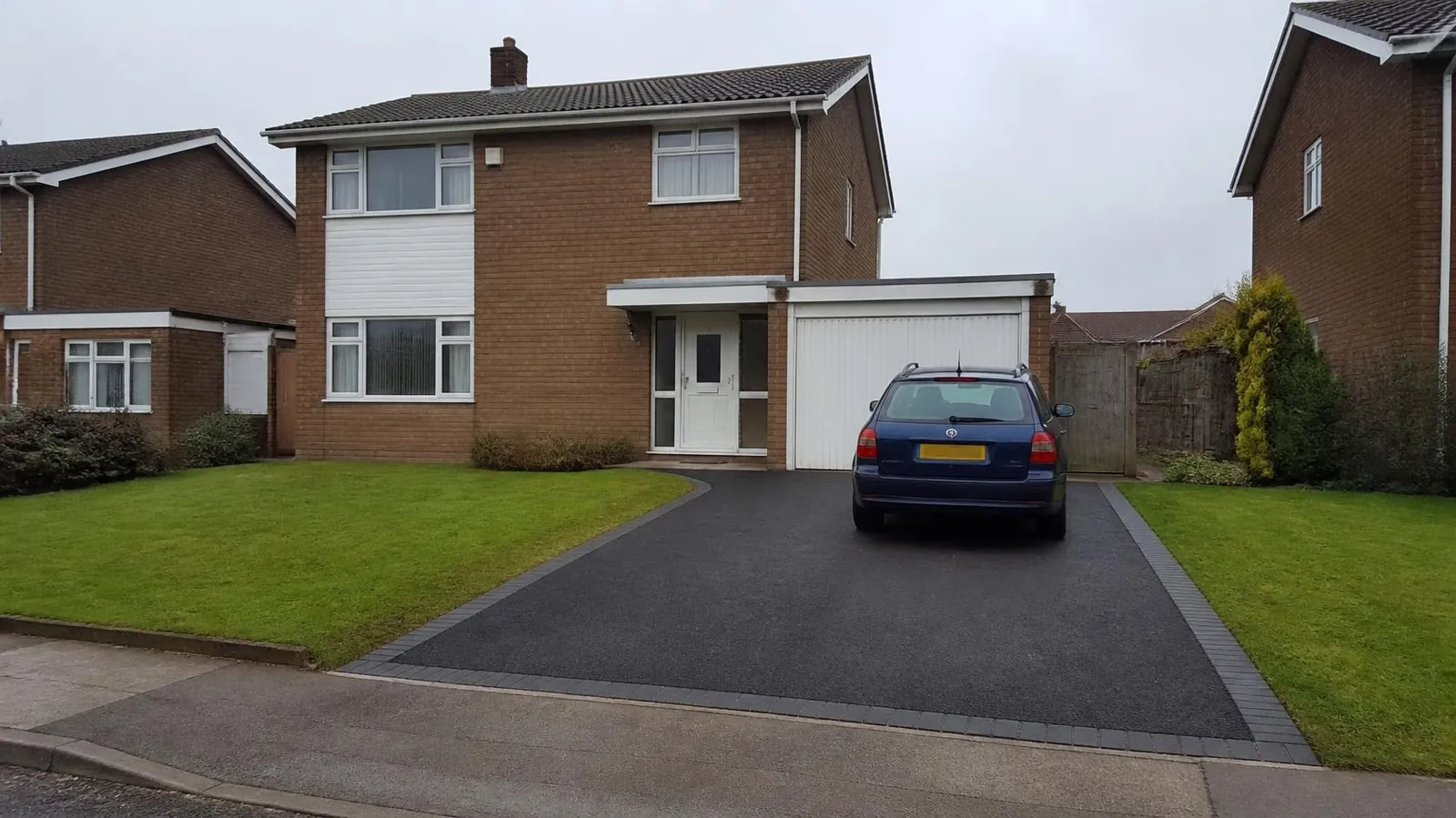
The Elm Tree frontage
Typical features of houses here:
- Open-plan front gardens with no wall, sloping gently to the pavement.
- An attached or integral garage with a single drive in front of it.
- Lots of cul-de-sacs, which means short, curved kerb lines and shared turning heads.
Because the lawn already runs to the pavement with no wall, adding a second parking space next to the existing drive is often straightforward on the house side. The constraint is usually the kerb.
Kerbs on curved cul-de-sacs
Widening a dropped kerb on a curve or at a turning head needs care with visibility and with neighbours' crossings. The council looks at each case. Apply to Stockton-on-Tees Borough Council before building the wider drive. Either accept its quote or use a contractor holding the council's Opening Up licence. See dropped kerbs and our comparison of council and private kerb routes.
Covenants and open-plan conditions
Some 1970s estates were built with legal covenants or planning conditions intended to keep front gardens open, for example limiting front walls, fences or hedges. These rarely stop a drive, but they can affect a new boundary wall or gate. Your title deeds will show any covenants.
Popular surfaces here
- Tarmac with a block border. Cost-effective for a wide drive, and the border gives a neat edge against the lawn. See tarmac driveways.
- Full block paving. Good on cul-de-sacs, where curves and the garage approach can be picked out with a contrasting course.
- Resin-bound. A smooth, permeable finish that suits modernised 1970s houses with new windows and cladding.
Drainage on the slope
Many Elm Tree frontages fall towards the road. A bigger drive collects more water, and on clay it will not soak away quickly. A channel drain across the bottom of the drive, feeding a soakaway sized for clay, or a permeable surface keeps water off the footway and within the front-garden rule. See permeable driveways.
Common questions
Can I widen my drive across the whole lawn?
Often, yes, but leaving some soft landscaping helps drainage and looks better. The kerb widening is the part that needs council approval.
Are there restrictions on front walls on 1970s estates?
Some estates have covenants or planning conditions. Check your deeds and the original planning permission.
Tarmac or block paving for a double drive?
Tarmac usually costs less per square metre on bigger areas. Block paving gives more design options and is easier to repair.
Will a wider drive affect my garage door?
New surfaces raise levels slightly, so the installer should check the threshold to make sure the door still opens.